Kan inte låta bli att förmedla denna artikel som fanns i gårdagens
Daily Nation. Den säger ungefär vad so alltid sagts om hjälp till Afrika även om det är allt annat än politiskt korrekt. Pengarna försvinner på vägen. Samma sak nu när väst skänker pengar till svälten i norra Kenya och i Somalia. Huvuddelen tas som "skatt" av kriminella ligor och säljs sedan på marknaderna. De allra fattigaste år naturligtvis ingen del i den sk hjälpen. Andra blir däremot rikare. Personligen tror jag att så länge hjälpen förmedlas av Afrikaner och på Afrikanernas vilkor så får de som verkligen behöver den ingenting.Det är något att tänka på när man skickar sina pengar i bla Sverige för att döva sitt samvete. De hungriga blir inte mättare av bidragen.
Aid comedy: Mosquito nets make nice wedding dresses and fish driers
By KAMAU MUTUNGA kmutunga@ke.nationmedia.com Posted Monday, September 19 2011
Africa is one of the world’s resource-rich continents, yet it is the most dependent on foreign aid, 50 years after colonial masters packed their imperial bags. And, besides its states being the most indebted, Africa is the largest producer of babies, and the least producer of food, according to the United Nations Development Program (UNDP). Look no further than Kenya. It has millions on the throes of starvation in the north, and needs food aid. Yet, it is an agricultural economy. Nigeria is one of the world’s largest oil producers, fourth actually. But electricity is yet to reach its rural areas as is the case in most African countries. In his 2006 book, The White Man’s Burden, William Easterly notes that the continent is dogged by lack of basic needs such as food, access to education, clean drinking water, health and shelter, despite the $500 billion disbursed in foreign aid over the last 50 years. The bulk of that dough was sunk in development projects meant to yank Africa out of blighting poverty. Volume of aid Well, Dr Kwame Akonor informs us in, Foreign Aid to Africa: A Hollow Hope? that “during the period when aid has risen overtime as a percentage of income in Africa, Africa’s growth has concurrently fallen.” And there is no evidence that more aid money has meant favourable development because, notes, Dr Akonor, “the total volume of aid, in and of itself, tells us nothing about how that money is disbursed or why a given project succeeds or fails.” In the end, the structure of African economies today, the volume of aid over the decades notwithstanding, remains as it was when British premier Harold McMillan said “the wind of change is blowing across Africa” in June 1960. The value of aid aside, Africa is its own worst enemy. The African Union estimates that the continent loses $148 billion — a quarter of its Gross Domestic Product — to corruption, annually. Development experts thus argue that Africa’s dependency has a lot to do with poor leadership than lack of money. The $500 billion given as aid up to year 2000 is not a lot as donors would have us believe though. According to Steven Radelet of the Centre for Global Development, that figure, over 50 years, averages to only about $10 per person per year or 20 cents per week per African. In low-income countries, argues Radelet, the figure further “works out to $14 per person per year — not exactly winning the lottery.” So, why does the West keep helping Africa? Former British Premier Tony Blair said during the Labour Party’s Annual Conference in 2001 that Africa was “a scar on the conscience of the world” and that the international community could heal it. Dr Akonor contends that it is under this moral obligation that Africa is helped to repair “the conditions of injustice and inequality that permeate the international political economy.” But this moral obligation only aids in stereotyping Africa as a “needy child,” a continent of “beggars” — a dubious reputation reinforced by the fact that African countries are the largest recipients of foreign aid. The UNDP claims that foreign aid provides governments with a resource for making multiple investments in health, education, and economic infrastructure needed to break cycles of deprivation. In short, Africa is helped, to help itself. But Dr Akonor sneers, “None of the foreign aid in Africa is aimed at transforming Africa’s structurally dependent economies.” Indeed, the International Finance Corporation, the private lending arm of the World Bank, found that only half of its projects in Africa succeed. Poorly designed aid projects resulted in perpetual dependence, far worse than the large sums forked out to actualise them. The primary true objective cited for African aid, says Dr Akonor, is to reduce poverty “in order to provide a bulwark against terrorism,” since the West reasons, poverty increases the susceptibility to violent extremism. Wasted, mismanaged and misdirected foreign aid in post-independence Africa has created a welfare dependent continent with an abysmal development record. Easterly notes that the big problem with foreign aid is that the bill is paid by “rich people who have very little knowledge of poor people.” Development in Africa has been long winding and laughably complex. Let’s, below, sample “good intentions” that came to monumental grief: Rollback Malaria, Kenya Multiple agencies aimed at raising $500 million in 1998 for the Rollback Malaria campaign “to halve the prevalence of malaria across Africa by 2010.” That figure was just a fraction of the $1.9 billion required by the World Health Organisation (WHO). The Rollback Malaria kitty only had $200 million by 2002. Two years later, the rate of malaria infection had not reduced, but had, instead, increased by 12 per cent, according to WHO. The year 2010 came and went. WHO said the fight against malaria was being waged “against a background of an increasing malaria burden.” One cause is the proboscis of a culture that sacks anti-malaria campaigns into the back-burner. Take Western Kenya, a malaria- prone region. In April this year, Quinto Ahindukha, the Western Provincial Director of public health and sanitation, attributed 30 per cent of child mortality there to malaria. That is 1,200 deaths monthly, on average. To “quinine” the situation, the Kenya government and NGOs embarked on anti-malaria campaigns. The Rollback Malaria Campaign continued encouraging the use of Insecticide Treated Nets (ITN) by pregnant mothers and children under five years of age. Cost being a factor, the nets were subsidised. Use of nets rose from seven per cent in 2004, to 67 per cent in 2007, reducing malaria deaths by 44 per cent. But alas! the gains made were a passing cloud. A study carried out in 2008 by Maseno University’s School of Public Health, Institute of Tropical Medicine, Nagasaki University, and ICIPE found that most of the long lasting mosquito nets were used for fishing and drying the catch because “they were free” and “fish dried faster on the nets.” The residents also dispensed with nets during hot weather. Women in Western Kenya sidestepped pre- and ante-natal care for fear of being tested for HIV. They preferred midwives, giving birth at home. Due to lack of immunisation of their children, measles shot up, alongside malaria. To rectify the situation, a double-barrelled campaign was mounted, giving a free mosquito net to every mother who took her child for immunisation against measles. But the onslaught of measles and malaria was unrelenting. Reason? Mothers were immunising their children twice: to get two nets — one for the child, the other for fishing — says the research. Not tailor-made for the lake, water hyacinth and all, the nets wore out, fast. And the spare nets at home came in handy. Note that, for maximum efficacy, only one injection is recommended against measles, rendering the exercise useless. Today, the mosquito nets are free. They are either green or blue, making it easy to apprehend those using them on Lake Victoria. And there will be a lot of apprehending to do since besides fishing, the recipients of nets in Western Kenya use them to cover backyard sukuma wiki and carrot gardens. The nets provide shade and ward off birds that destroy the nurseries. These residents would rather their “children contract malaria on a full stomach than die of hunger.” In Zambia, it is an offence under the Public Health Act to misuse mosquito nets. But street vendors there still use them to cover food, while tailors find them ideal for making wedding dresses. A bakery and a groundnut army Canada constructed for Tanzania an automated bakery in Dar es Salaam, with the whiff of freshly baked bread wafting alongside Dar’s coastal breeze in 1976. But the automated bakery closed shop five years later, going down as one of the worst cases of inappropriate aid in Africa. It creamed the Canadian taxpayer of $1.7 million — three times the projected cost by the Canadian International Development Agency. One condition for erecting the bakery was the appointment of Canadian consultants, and Angus Butler Engineering Company of Alberta, it was. The travelling expenses for Butler experts pushed up expenses by 7.5 per cent, according to a 1978 survey by the Institute of Development Studies, Brighton England. The machinery was suitable for conditions in Alberta, and could have been acquired for half the price, had they been bought in Germany or Japan, the survey later revealed. Instead of helping Tanzanians, the bakery only increased demand for Canadian wheat, besides running bakeries already operating in Dar out of business. It was later found that 10 smaller bakeries with simpler technology could have produced similar volumes as the Canadian bakery, which messed up Tanzanian currency exchange ratios due the demand for Canadian dollars to pay for the wheat. The Canadian bakery employed 60 people. The 10 local ones could have absorbed 350 Tanzanians, the study noted. The smaller bakeries could have relied less on Canadian spare parts, thus curbing vulnerability to breakdowns. But before Canadian wheat, was the British “groundnut army.” Tanzania was a German colony until the League of Nations transferred its administration to Britain. In 1946, the Labour Government of Clement Atlee sought to stock its national granary while improving agricultural production in East Africa via encouraging the colonies to grow and export groundnuts, to curb the shortage of edible oil occasioned by the vagaries of World War II. British explorer Henry Morton Stanley had described Tanzania, then named Tanganyika as “an interminable jungle of thorn bushes” where over 100,000 square kilometres of land and £25 million were committed to the groundnut project, the original idea of Frank Samuel, head honcho of United Africa Company, writes Alan Wood in, The Groundnut Affair. United Africa, a subsidiary of consumer products giant Unilever, required vegetable oil to manufacture its products. There were fears that vegetable oil would be in short supply. Groundnuts would come in handy. United Africa Company would face unnecessary bureaucracy in starting a farming project, hence Samuel’s muse that the newly elected Labour government take it up. To make the groundnut project a success, people were displaced and lives altered. Many things were ignored though: Groundnuts require at least 500mm or 20 inches of rainfall annually. Wood notes that the area chosen, at the suggestion of a pig farmer, was the drought-prone Kongwa, a district in Dodoma. Wildlife hazards and labour concerns — locals only worked during the wet season — grounded the groundnut project that had swollen its budget to £49 million by 1951. And now an interesting tale from Ethiopia: The vagaries of intermittent outbreaks of drought and famines stretching back to the 16th century have made Ethiopia one of the most food insecure, and thus food aid dependent countries anywhere. The United Nations donated 1.5 million tonnes of grain to Ethiopia in 2003, recalls Meron Assefa Arega in a study titled, The Impact of Food Aid on Grain Prices in Ethiopia. But that “help” only benefited farmers in the donor countries where the UN sourced the grain. The donation flooded the grain market, eroding prices. It cost an Ethiopian farmer $50 (Sh5,000 today) to produce one tonne of grain, but $25 (Sh2,500) to sell it in the open market due to decreased demand, further decreasing food production after farmers gave grains a wide berth. Oil pipe line, Chad-Cameroon The World Bank committed $4.2 billion (Sh420 billion) for the construction of an oil pipeline from Chad through Cameroon to the Atlantic Ocean. It became Africa’s biggest development project upon its completion in 2003. The idea was to develop Chad. The project to drill 300 oil wells with the capacity to extract 225, 000 barrels of oil daily with a 650 mile pipeline through Chad and Cameroon would bring foreign exchange via exporting the oil to Europe and North America, according to the World Bank. A consortium comprising ExxonMobil and Chevron from America and Petronas of Malaysia won the bid in one of the riskiest projects ever undertaken by the bank. But President Idriss Deby decreed that oil money be included into Chad’s 2005 national budget. To sign the deal, Deby demanded $25 million as a “signing bonus”. The tidy sum was used to, among others, buy weapons to defend the south against armed rebels in the north. Or else foreign oil concerns would be expelled pronto! That was in contravention of the agreement with the World Bank, which announced its withdrawal from the project in September 2008. The oil revenues were to be used to construct schools, hospitals, roads and so on. Currently, though it is the second most expensive country to live in in Africa, after Angola, according to Mercer’s 2011 Cost of Living Survey. N’Djamena, the “dead heart of Africa” and Chad’s rickety capital, is the world’s third most expensive city ahead of Moscow, Russia and Zurich, Switzerland. The United Nation’s Human Development Index 2010 ranks Chad the seventh poorest country in the whole wide world. By 2004, Chad had 550 kilometres of road. Over 80 per cent of its 10 million people depend on subsistence farming. Cotton, not oil, being the primary export. Idrisss “Itno” Deby, the former herder and trained pilot is still the president of Chad, which in 2006, was ranked by Forbes as one of the world’s most corrupt countries for “what may turn out to be the single most piggish use of philanthropic funds.”


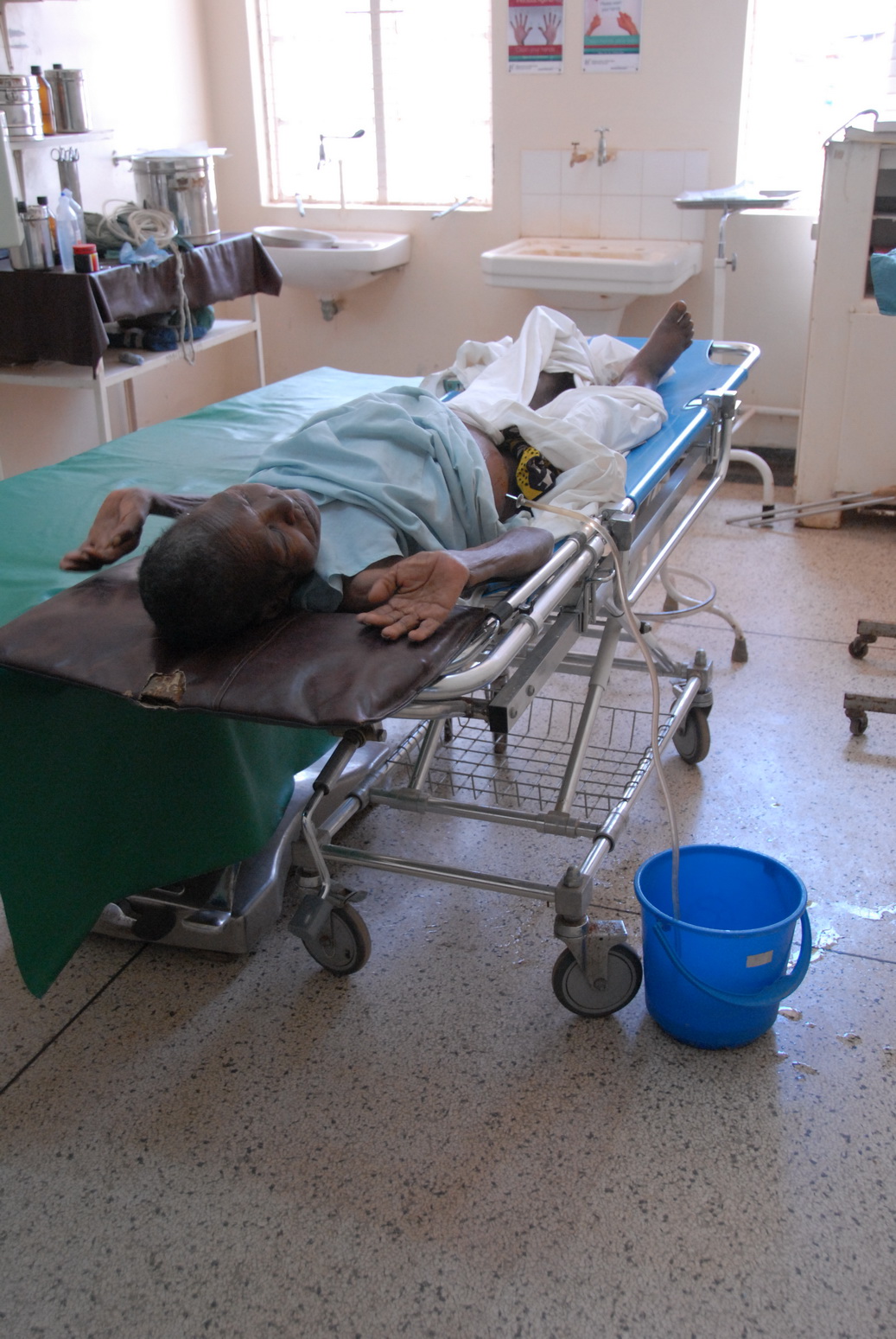


 Ormbett. Denna kvinna blev biten i sin hydda/hus av en kobra. De lesta kommer inte in eftersom de dör innan men hon kom in för några dagar sedan och fick bla serum och överlevde. Handen var lite svullen och det såg på det stora hela rätt ok ut. Som alla andra fick hon antibiotika. Skrev ut henne igår då det var i stort sett bra men hon gick inte hem, som alla andra, då hon inte hade pengar. Idag såg det ut såhär. Svullet, necrotiskt, luktade död o förruttnelse och droppade var o annat ur året. När jag lyfte på locket var det necrotiskt ner till fascian och ligamenten höll/håller på att gå åt pipan. Necrosen fortsätter långt in under. Nu får vi se vad som händer de närmasta dagarna. Ormar är inget man leker med.